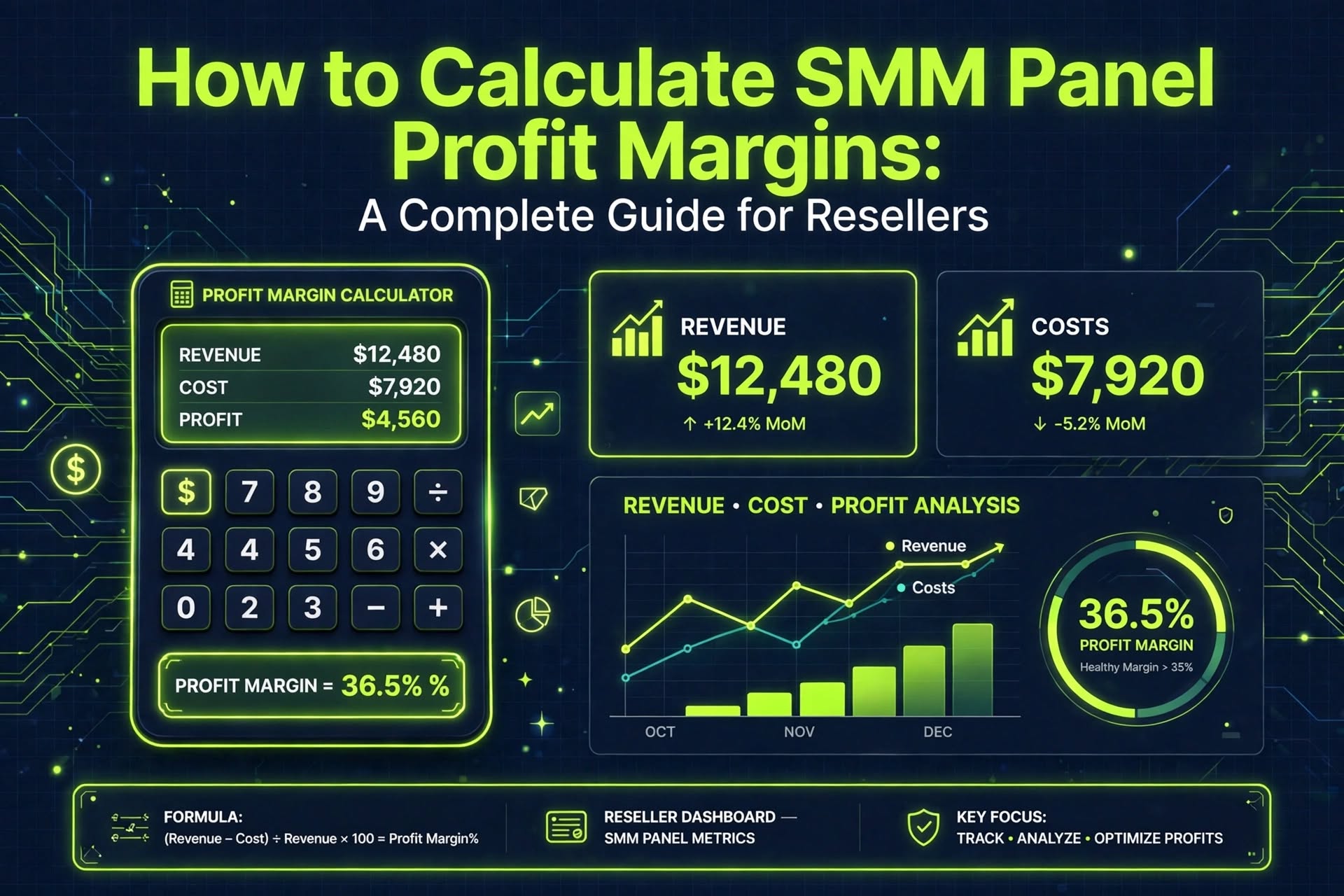
How to Calculate SMM Panel Profit Margins
How to Calculate SMM Panel Profit Margins: A Complete Guide for Resellers
Running an SMM reseller business involves more than choosing services and setting selling prices. To operate sustainably, you need to understand how much each order costs, how much revenue it generates, and how much profit remains after expenses.
A service may appear profitable when you compare its purchase price with its selling price. However, payment fees, hosting, refunds, currency conversion, and other operating expenses can reduce your actual earnings.
In this guide, we will explain how SMM panel resellers can calculate profit margins, set prices, manage expenses, and make more informed business decisions.
What Is an SMM Panel Profit Margin?
Profit margin measures the percentage of revenue that remains as profit after the relevant costs are deducted.
For an SMM reseller, profitability can be assessed at different levels:
- Gross profit: Revenue minus the direct cost of fulfilling orders.
- Operating profit: Profit after operating expenses are deducted.
- Net profit: The amount remaining after all applicable expenses and other relevant charges are accounted for.
Understanding these differences helps you avoid confusing sales revenue with actual earnings.
1. Calculate Your Direct Service Cost
The first step is to determine how much it costs to fulfil an order.
Your direct costs may include:
- The provider's service charge
- Applicable transaction fees
- Currency conversion costs
- Other expenses directly associated with the order
For example, suppose a reseller purchases a service for $7 and sells it for $10.
The gross profit before other costs is:
Gross Profit = Selling Price − Direct Service Cost
$10 − $7 = $3
The reseller earns $3 in gross profit on that example order, before other expenses.
2. Understand the Profit Margin Formula
Profit margin and markup are different calculations.
The gross profit margin formula is:
Gross Profit Margin = (Gross Profit ÷ Selling Price) × 100
Using the previous example:
- Selling price: $10
- Direct service cost: $7
- Gross profit: $3
Gross profit margin = ($3 ÷ $10) × 100 = 30%
This means gross profit represents 30% of the selling price before other operating expenses.
Markup, by contrast, measures profit as a percentage of cost:
Markup = (Gross Profit ÷ Direct Cost) × 100
In this example, markup is ($3 ÷ $7) × 100, or approximately 42.86%.
The two percentages are not interchangeable.
3. Include Operating Expenses
Your business may have expenses even when no individual order is being processed.
Common examples include:
- Domain registration and website hosting
- Software subscriptions
- Payment gateway charges
- Advertising and marketing
- Customer support
- Administrative expenses
- Refunds and other losses
Suppose your business generates $1,000 in monthly revenue and has $700 in direct service costs.
Your gross profit is $300.
If your additional operating expenses are $150, your operating profit before any other applicable expenses is $150.
Operating profit margin:
($150 ÷ $1,000) × 100 = 15%
This example demonstrates why a reseller should track operating expenses rather than relying only on the difference between purchase and selling prices.
4. Account for Payment and Currency Conversion Fees
Payment costs can affect profitability, especially when your provider charges in one currency and your customers pay in another.
Consider the following example:
- Customer payment: $20
- Direct service cost: $13
- Payment and conversion costs: $1
Profit before other operating expenses:
$20 − $13 − $1 = $6
Your contribution from that order is $6 before allocating general business expenses.
Actual payment costs depend on the payment provider, transaction type, currency, and applicable rates. Use your real transaction records instead of assuming that every payment has the same fee.
If you operate in Bangladesh or another market where exchange rates affect your costs, record the actual amount charged in your operating currency.
5. Set a Sustainable Selling Price
Pricing too low can make it difficult to cover your costs. Pricing too high may make your offer less competitive.
A useful starting point is to calculate the price needed to reach a target gross margin.
The formula is:
Selling Price = Direct Cost ÷ (1 − Target Gross Margin)
Use the margin as a decimal in the formula.
For example, if your direct cost is $8 and your target gross margin is 20%:
Selling price = $8 ÷ (1 − 0.20)
Selling price = $8 ÷ 0.80 = $10
At a $10 selling price, the gross profit is $2, representing a 20% gross margin before additional expenses.
Remember that a target gross margin does not guarantee the same net profit margin. You still need to account for payment fees, refunds, and operating costs.
6. Track Profitability by Service
Not every service has the same cost structure or demand.
Create a simple record for each service containing:
- Service name or identifier
- Provider cost
- Selling price
- Payment fees
- Refunds or other direct losses
- Number of orders
- Gross profit
This helps you identify which services contribute most to your business.
A service with a high margin may have very few orders. Another service may have a smaller margin but contribute more total gross profit because it sells more frequently.
Evaluate both margin percentage and total profit rather than relying on a single metric.
7. Calculate Your Break-Even Point
The break-even point is the level of sales at which your contribution from sales covers your fixed operating costs.
A simplified formula is:
Break-Even Sales = Fixed Costs ÷ Contribution Margin Ratio
Suppose your monthly fixed costs are $120 and your contribution margin ratio is 40%.
Break-even sales = $120 ÷ 0.40 = $300
Under these assumptions, you need $300 in sales to cover the $120 in fixed costs.
This example assumes the contribution margin ratio remains constant and that the stated costs include the relevant variable expenses. Real business conditions may be more complex.
Knowing your break-even point can help you set realistic sales targets and evaluate whether your current pricing model is sustainable.
8. Monitor Refunds, Failed Orders, and Service Issues
Refunds and failed orders can reduce the amount your business keeps.
Keep records of:
- Cancelled orders
- Refund amounts
- Provider credits
- Payment disputes
- Service-related losses
- Additional support costs
Review these records regularly to understand their impact on profitability.
Do not assume that a refund from a customer will automatically be matched by a refund from your provider. The applicable terms may differ.
Clear service descriptions and transparent policies can help customers understand what they are purchasing and how issues will be handled.
9. Use a Monthly Profit Report
A monthly report can help you understand the financial performance of your SMM reseller business.
Track these figures:
1. Total revenue
2. Direct service costs
3. Gross profit
4. Payment and currency conversion fees
5. Advertising and other operating expenses
6. Refunds and other losses
7. Net profit
8. Net profit margin
Net profit margin is generally calculated as:
Net Profit Margin = (Net Profit ÷ Revenue) × 100
Use consistent accounting categories so that you can compare one month with another.
Your accounting treatment may vary depending on your jurisdiction and business structure. Keep appropriate records and seek professional accounting advice when necessary.
Common Pricing Mistakes SMM Resellers Should Avoid
Confusing Markup With Margin
A 30% markup does not produce a 30% profit margin. Use the correct formula for the metric you want to measure.
Ignoring Small Fees
Small transaction fees can accumulate across many orders. Include relevant fees when evaluating profitability.
Competing Only on Price
The lowest price is not always the best offer. Clear information, reliable support, and transparent policies can also matter to customers.
Treating Revenue as Profit
A high sales figure does not automatically mean the business is profitable. Subtract the appropriate costs before assessing performance.
Failing to Review Prices
Provider costs, payment fees, exchange rates, and market conditions can change. Review your pricing periodically and update it when necessary.
Frequently Asked Questions
What is a good profit margin for an SMM reseller?
There is no universal ideal margin. It depends on service costs, operating expenses, competition, demand, and the level of support you provide. Calculate your costs before choosing a target.
What is the difference between markup and profit margin?
Markup compares profit with cost, while profit margin compares profit with selling price. They measure different things and produce different percentages.
Should I include hosting and advertising in my calculations?
Yes. Include relevant operating expenses when evaluating the overall profitability of your business. For service-level analysis, you can track direct costs separately from general overhead.
How often should I review my prices?
Review prices regularly and whenever significant provider costs, transaction fees, or exchange rates change. Use actual financial records to guide adjustments.
Can an SMM panel guarantee reseller profits?
No. Profitability depends on your costs, pricing, demand, service quality, and business operations. A platform or provider cannot guarantee that your reseller business will make a profit.
Final Thoughts
Calculating SMM panel profit margins helps resellers understand whether their pricing is sustainable and where their money is going.
Start by recording direct service costs, calculating gross profit, including payment fees, and tracking operating expenses. Then review service-level performance and monthly financial results.
By using accurate figures instead of guesswork, you can make better pricing decisions and build a more financially informed reseller business.
If you are exploring SMM panel services through SMMMarkets, review the current service details and applicable costs carefully before setting your own prices.